
Kid Gloves
An open letter to a young Arkansas teen interested in falconry

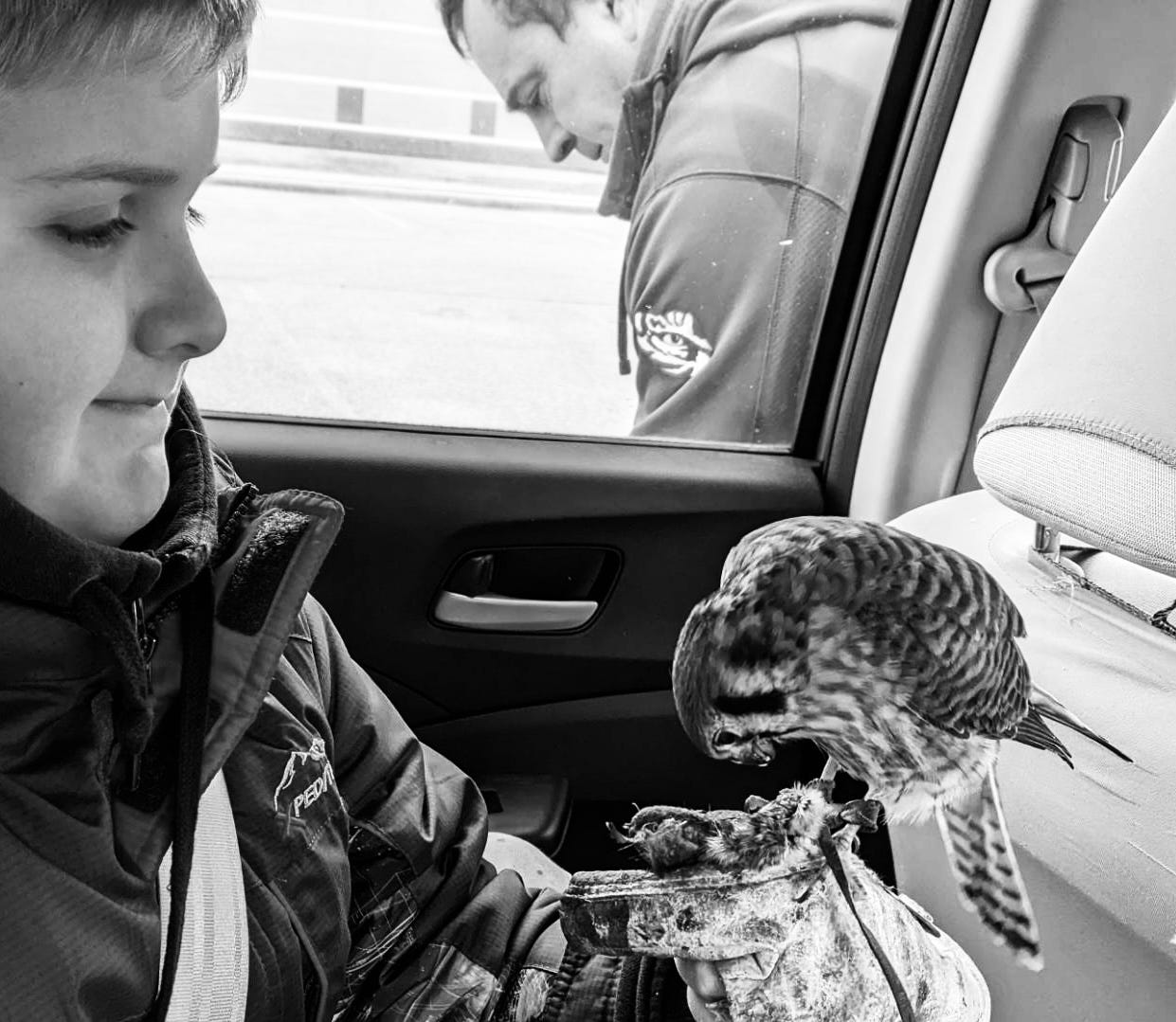
Something occurred to me while speaking with you and your mother about the possibility and process of becoming a falconer, as I did, at the age of thirteen.
Which is: There’s no “kids’ version” of falconry.
No padded gear for the junior players.
No little league; no special rules for minors; no handicap calculus; no form of the sport less risky or lethal than the one practiced by everyone else.
One foot in, and you’re all the way in.
When you trap and train and fly a hawk, you must do all the necessary things, same as everyone else; neither your age, gender, nor physical fitness provide any special dispensation.
None of that matters to a hawk. The hawk’s world, which includes the field, quarry, weather, and every kind of luck, couldn’t care less.
Step on to the field, and you’re a player.
Of course, you will need practical help and guidance in a hundred things along the way. But so will an apprentice twice your age.
You will suffer and fail and succeed in more or less equal amounts to the other rookies, regardless which grade you’re in or whether or not you can buy a beer or mortgage a house.
Your first hawk could be anyone’s first hawk. It won’t care who its first human happens to be.
But in one way you will be unique.
As a new teenager, you’ll likely be the youngest person in the room. Your voice will be small and halting, should you choose to use it.
You won’t have much to say that seems to impact the assembled adults—the parent-aged men and women and those shading into gray, and the genuine old timers who may not acknowledge you at all.
You might sit in a corner on a cooler, as I did, bathing in the florescent light of a hotel hospitality room and in the laughter of large people you know only vaguely, except that they have hawks, too.
It can be lonely at times, but for the birds, who don’t measure social distance in years, or by the shape of your face, or your standing height in hunting boots.
Birds measure you against their own needs being met and by the value they see in you to provide.
For the rest of your life, that will be the one measure of your worth you can count on never to change. Your last hawk will judge you by the same standard as your first.
If you’re prepared to meet that standard, then your first step into the field of falconry is already behind you.
Reading this is like reading words from a thousand years ago, ancient, timeless, wise.
As our favorite agrarian writer would say, “This is good work.”