
Safety Concerns
On falconers’ constant assumption of invisible threat

Forget any notion that your falconry is safe. Even the shortest slip in the tamest habitat is an excursion into utter wilderness.
The outcome of a simple ambush flight—say, at a starling on a mowed lawn—may be statistically secure, but given enough slips, the odds are always against you.
That falconry is inherently, inescapably dangerous is a matter of context: While you may control two or three of the most influential variables in any flight, the slip occurs in a larger context no smaller than the whole world, within which are unavoidable mountains of probability that a predator, a fence or power line, a swift stream, a semi-trailer, or some other dangerous vector will eventually intersect with your own.
This is what distinguishes falconry from a game—what makes it both great and terrible, simultaneously.
Prevention of all danger is impossible, but a measure of safety is achievable with some attention to detail and a healthy respect for the unknown. These have always been the required tools of wilderness adventure.
Here’s a primer on three basic kinds of danger to keep in mind.
The Known Knowns: A familiar hawking spot is usually safer than a new one, if only because the location of its power poles, cross streets, backyard pets and other potential dangers are known and can be navigated.
But nothing invites disaster like overconfidence. The existence of these particular threats suggests your spot (like many of ours) is close to human habitation and thus impossible to prevent incursions by stray dogs, unhoused people, murders of crows, and etc.
Hawking in such environments requires excellent recall— the falconer’s ability to retrieve a hawk quickly in case of danger, and the bird’s own understanding of its purpose there, so that it doesn’t wander off.
The Known Unknowns: If flying a small bird at small birds, it’s best to assume a Cooper’s hawk is somewhere close, waiting to speed between your legs and snatch your hawk. In parts of the world without Cooper’s hawks, trust that some similar short-winged devil is happy to fill in this role.
And if you’re flying a large hawk, assume that something even larger lurks nearby or is watching from the ridge top or a thousand feet above you in a thermal.
Good recall won’t always save you from these dangers, so a constant assumption of invisible threat is a healthy attitude to take when hawking. Realize that the same circumstances you’re creating for your hawk to succeed will just as easily serve a wild one, and that the wild ones are watching.
The Unknown Unknowns: Fortunately, these become fewer with time and experience in the sport. As our favorite hawks are eventually picked off by predators or lost to the wind or windows, bullets or aspergillosis, the number of Unknowns retreats into that steady background static of anxiety shared by all experienced falconers.
Cultivating this general unease into a useful sixth-sense is something I’ve come to value both in myself and my hawking friends, most of whom won’t hesitate to raise a hand if anything looks amiss. In the unending effort to avoid disaster, I’ve learned to trust the gut of the most experienced falconer in the field.
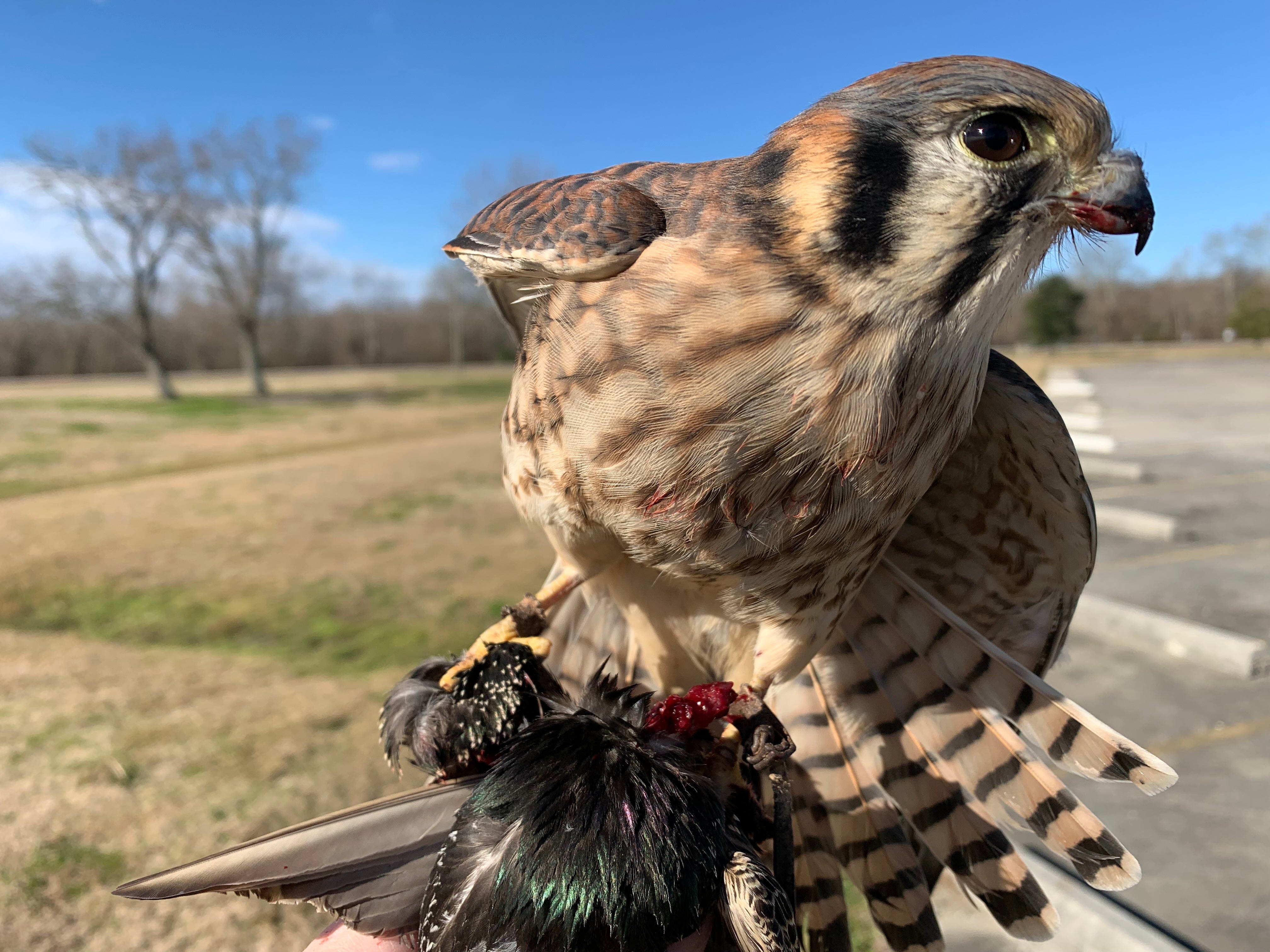
Especially if you are flying a kestrel!
I was braced for a story here, involving Coco, and I didn't want to hear it. Thanks to the Fates it didn't come. What has become of the new merlin?